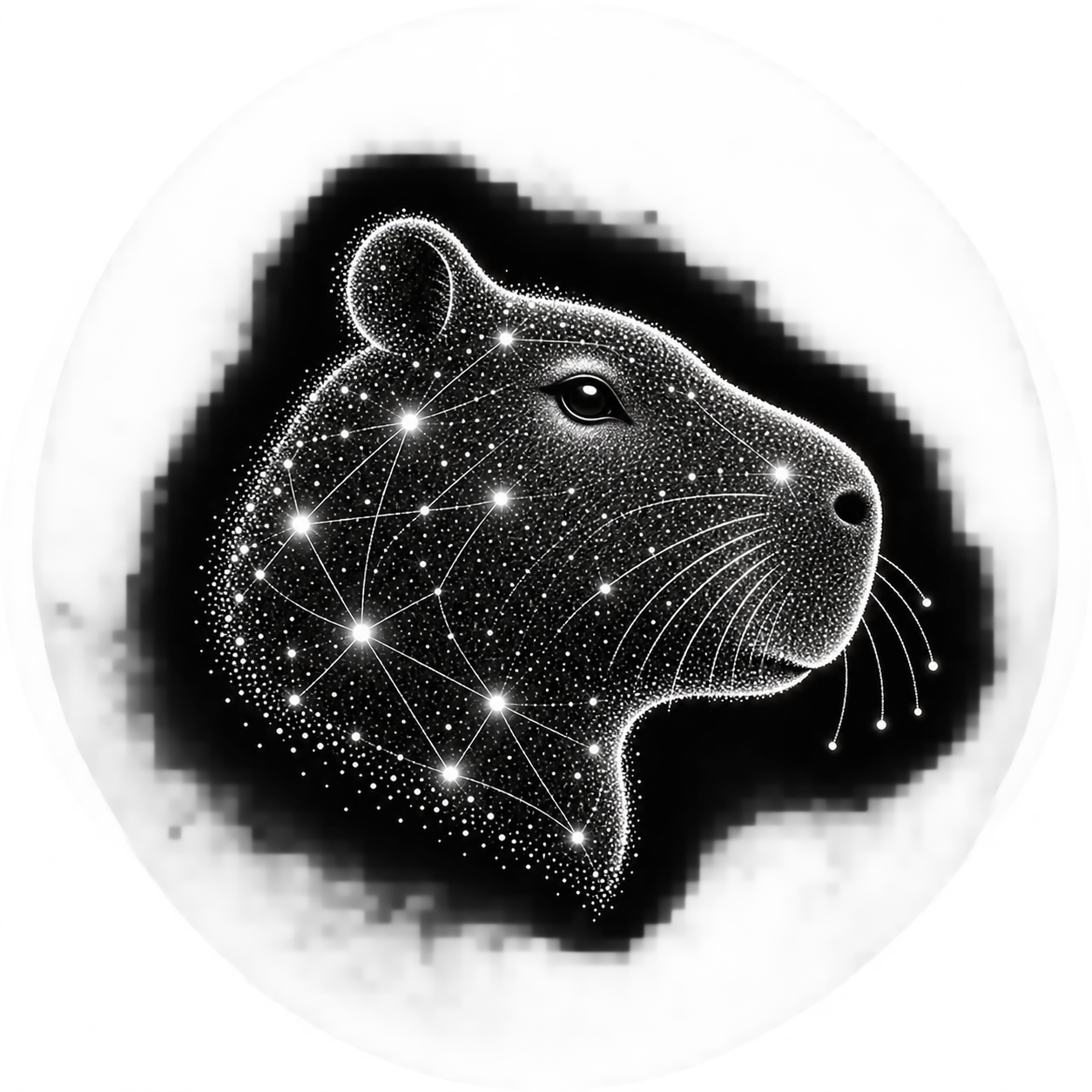
CAPYBRAIN studies how capybara-like behavioral drives can become a legible computational system and, eventually, a persistent virtual companion.
SYNTHETIC COGNITION ATLAS / V0.105 CIRCUITS / 54 REGIONS
CAPYSTATE ENGINE
HOVER OR SELECT A CIRCUIT / WATCH THE PATH RESPOND
FUNCTIONAL CIRCUIT01 / 05
LOW AROUSAL / STEADY RESPONSE
Calm regulation
Balances novelty and safety so the companion can settle instead of reacting to every change.
OBSERVABLE INPUTS
safety / energy / recent care
MODEL ROLE
Changes synthetic activation and companion state.
Behavioral circuits
05
Synthetic regions
54
Recurrent updates
08
Model status
Prototype
THE RESEARCH PIPELINE
From observed behavior to visible computation.
The system begins with recognizable capybara patterns: calm regulation, social proximity, vigilance, routines and habitat response. Those concepts become controllable signals, not invented anatomy.
01
Behavioral observation
Translate calm, social contact, vigilance, routine and habitat into explicit model inputs.
OPEN METHOD02
Synthetic cognition
Study how those drives interact inside a fixed, inspectable recurrent network.
OPEN METHOD03
Behavioral readout
Turn network state into understandable tendencies without claiming emotion or consciousness.
OPEN METHOD04
Companion continuity
Test how local memory and repeated care can make a digital presence feel familiar.
OPEN METHOD
MODEL / SYNTHETIC COGNITION
A functional atlas, not a fictional brain scan.
The lab contains 54 abstract regions connected by fixed, signed weights. Five explicit behavioral drives provide the input. Eight recurrent updates combine new signals with previous state through a visible nonlinear process.
The layout is organized around calm, social proximity, habitat, routine memory and vigilance. It is an engineered model inspired by observable behavior, not a measured capybara connectome. The 3D graph, adjacency matrix and region inspector expose the same computation.
METHOD / OPEN BY DESIGN
01
OBSERVE
Start with visible behavior and environmental context.
02
ENCODE
Map five named drives to a normalized input vector.
03
PROPAGATE
Run eight recurrent updates through fixed signed links.
04
READ OUT
Convert the final state into an inspectable response tendency.
LIVE PROTOTYPES
Research you can touch.
EXPERIMENT 01
Cognition network
Move five behavioral drives, propagate eight updates, rotate the graph and inspect every region.
CAPYBRAIN does not use or claim a complete capybara connectome. Its 54 regions and links are an engineered functional atlas, not a reconstruction of tissue, neurons or consciousness.
The value of the prototype is inspectability: every input, connection, update and readout can be seen. When future work uses real observations or external data, its source and limitation will be named.
 CAPYBRAIN